An inside look at SABRENT’s technology ecosystem, from its storage innovations and connectivity solutions to the small upgrades that make a remarkable difference in everyday computing.
The Technology You Notice Only When It Stops Working
A powerful computer is only as useful as the connections surrounding it. Fast storage becomes frustrating when transferring files takes too long. A premium laptop feels limited when there are not enough USB ports. Even a carefully organized workspace can become cluttered with charging adapters, external drives, and tangled cables.
SABRENT has built its identity around solving these practical technology problems. Known for its SSD storage solutions, USB hubs, docking stations, charging equipment, and computer accessories, the brand occupies an important space between advanced computing hardware and everyday usability.
What makes SABRENT interesting is not simply the number of products in its catalog. It is the company’s ability to recognize where digital workflows become unnecessarily complicated and develop hardware that helps remove those obstacles.
For professionals, content creators, gamers, and everyday computer users, this approach makes SABRENT more than an accessory manufacturer. It positions the brand as a practical partner in building a more capable digital environment.
From Computer Components to a Global Technology Ecosystem
The Evolution of an American Technology Brand
SABRENT’s story began in Pittsburgh, Pennsylvania, in 1998, when consumer computing looked very different from today’s highly connected digital environment. The company relocated to Los Angeles in 2001 and gradually expanded from computer components into a broader range of hardware accessories and storage technologies.
Its development accelerated as online retail created new opportunities to reach technology enthusiasts directly. SABRENT began selling through Amazon in 2012 and expanded internationally in 2015. A major turning point followed in 2018, when the company entered the solid-state drive market.
Today, SABRENT reports serving customers in more than 100 countries with a catalog exceeding 400 products. This growth reflects an evolution from supplying individual computer accessories to developing solutions for increasingly complex technology setups.
Why Its Brand Positioning Is Different
SABRENT operates in a market where buyers often face two extremes: inexpensive accessories with limited functionality and expensive professional equipment with features they may never use.
Its product philosophy aims to bridge that gap through reliable engineering, competitive pricing, and practical functionality. The company also emphasizes recognizable product design, accessible technical support, and clear warranty arrangements.
Three characteristics help define its market position:
- Performance with purpose: Technical specifications are connected to recognizable computing needs.
- Broad compatibility: Products address different operating systems, device generations, and hardware configurations.
- Scalable solutions: Customers can begin with a simple adapter and gradually expand toward more advanced storage or workstation equipment.
This combination gives SABRENT relevance across several customer groups without requiring them to adopt an entirely new technology ecosystem.
One Brand, Multiple Ways to Improve a Digital Workspace
A useful way to understand SABRENT is to organize its products around the problems they solve rather than their hardware categories.
Storage solutions help users manage increasingly large files. USB hubs expand the physical capabilities of compact computers. Charging stations reduce the inconvenience of multiple power adapters, while high-bandwidth cables connect devices that demand substantial data and display performance.
SABRENT also offers equipment for drive maintenance, data migration, and workspace cleaning. Together, these categories address different stages of technology ownership, from initial setup and daily productivity to long-term equipment care.
The following six products illustrate this philosophy without representing the full breadth of the company’s portfolio.
Six SABRENT Products That Demonstrate Its Practical Engineering
1. SABRENT USB-C NVMe Enclosure: Give an SSD a Second Life
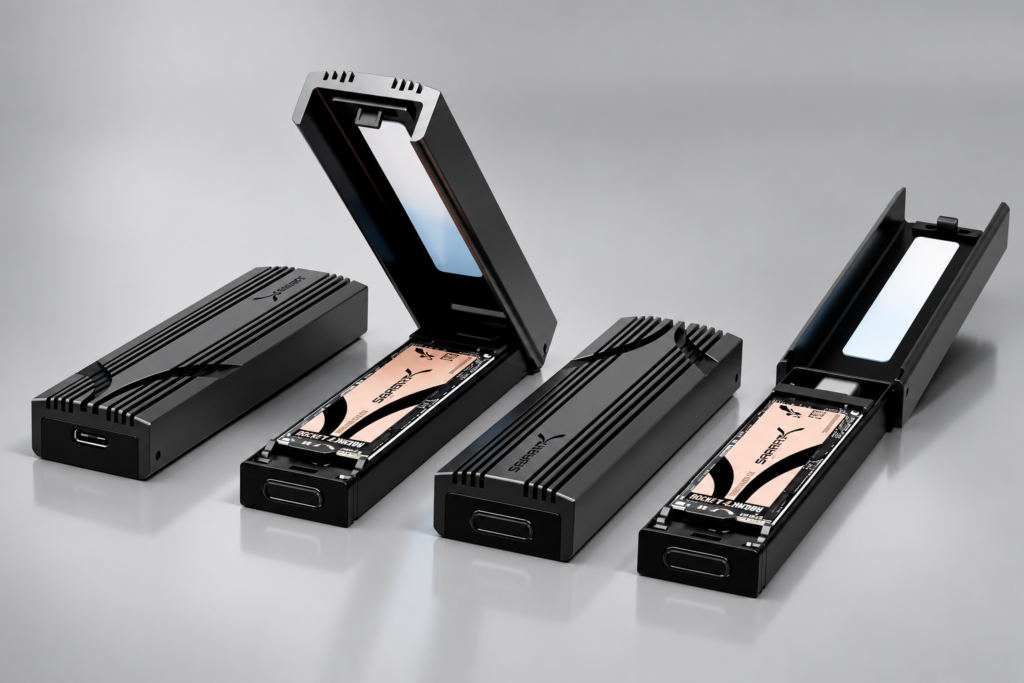
The SABRENT EC-PNVO transforms a compatible internal M.2 PCIe NVMe SSD into portable external storage. Supporting 2230 through 2280 drive sizes, the tool-free enclosure uses USB 3.2 Gen 2 connectivity rated at up to 10Gbps.
Its aluminum construction supports heat dissipation, while the compact design makes it useful for transferring files, repurposing an upgraded SSD, or preparing a storage migration.
Ideal for: Laptop upgraders, photographers, and professionals who frequently move large files between compatible devices.
2. SABRENT VOLTIK 252W Charging Station: Centralized Power Management
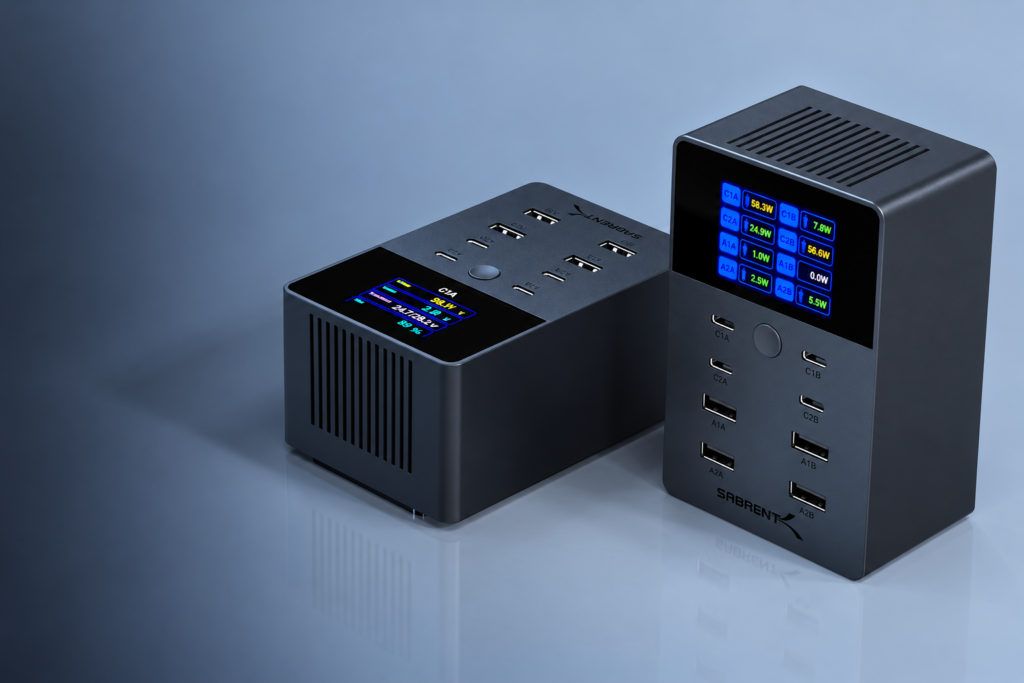
The VOLTIK AX-8PTC combines four USB-C ports and four USB-A ports in one desktop charging station, offering up to 252W of shared total output. Individual USB-C ports support up to 100W under applicable conditions.
Its color LCD displays charging information, including wattage, voltage, and current, helping users understand how power is distributed.
Ideal for: Shared workspaces, home offices, and households managing laptops, tablets, smartphones, and multiple accessories.
3. SABRENT 7-Port USB-C Hub: More Connections, Better Control
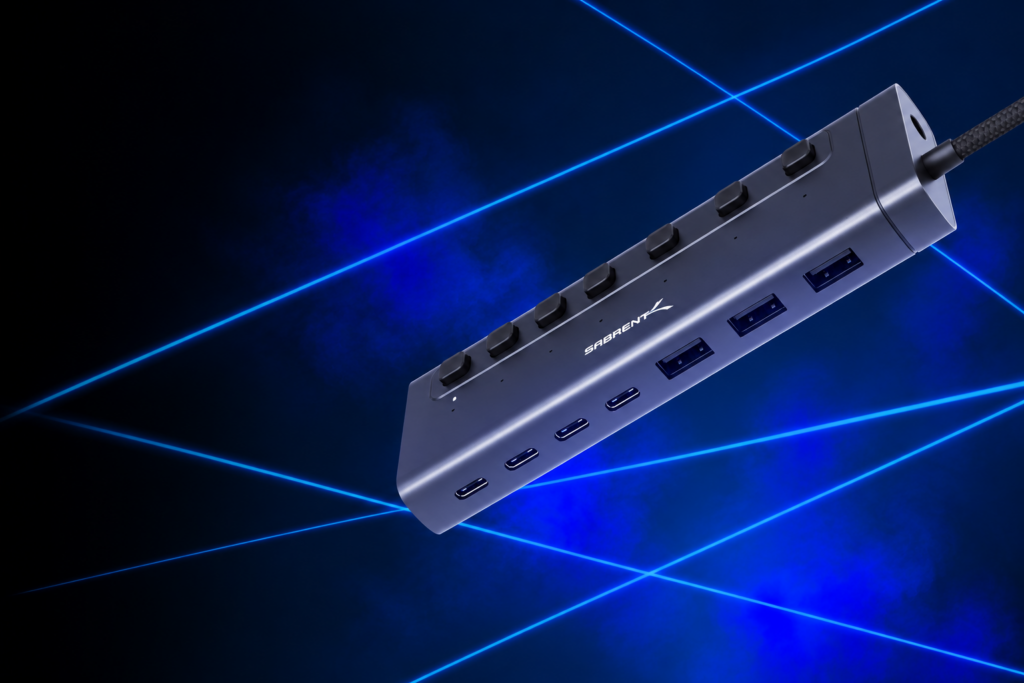
The HB-3A4C provides three USB-A and four USB-C ports, each supporting data speeds up to 5Gbps. Individual power switches and LED indicators allow users to control connected peripherals without repeatedly unplugging cables.
Its included 48W power supply supports connected devices, while one USB-C port offers up to 20W Power Delivery output.
Ideal for: Desktop users, laptop owners, and handheld gaming setups requiring additional peripheral connections.
4. SABRENT 4-Bay Hard Drive Dock: Simplifying Storage Management
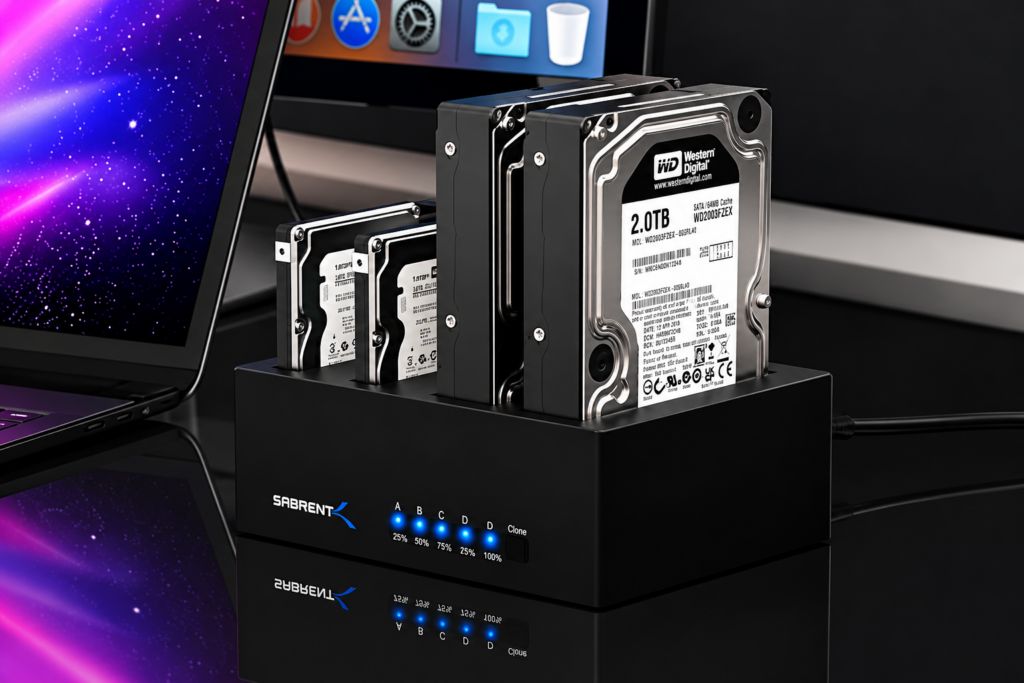
The DS-U3B4 accommodates four 2.5-inch or 3.5-inch SATA hard drives or SSDs through a trayless design. It supports USB 3.0 transfers up to 5Gbps and offers offline cloning without requiring a computer.
This makes it useful for drive migration, accessing archived data, and maintaining multiple storage devices.
Ideal for: IT technicians, data archivists, and users managing several drives. Offline cloning erases destination drives, so existing data must be backed up first.
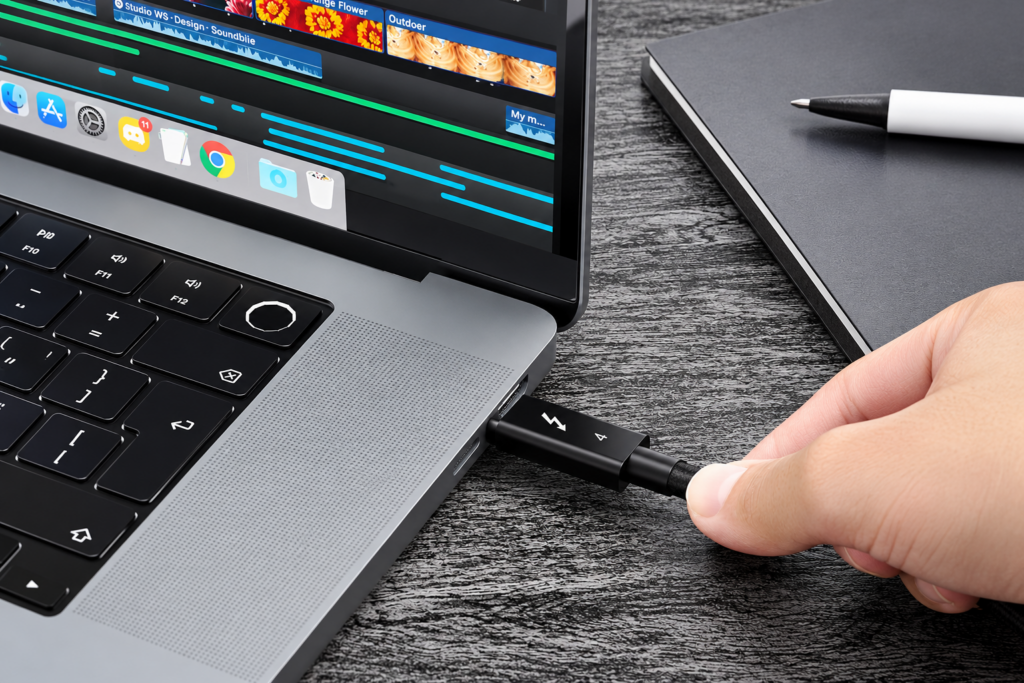
5. SABRENT Thunderbolt 4 Cable: High-Performance Connectivity
The certified CB-T4M2 is a two-meter Thunderbolt 4 cable supporting up to 40Gbps data signaling and 100W USB Power Delivery. Its E-Marker chip helps compatible equipment identify supported electrical capabilities.
With DisplayPort 1.4 support and potential 8K display connectivity, it is designed for demanding storage and display setups.
Ideal for: Creative professionals, Thunderbolt dock users, and advanced laptop workstations. Actual capabilities depend on the connected devices.
6. SABRENT BLOWZER X6: A New Approach to Equipment Maintenance
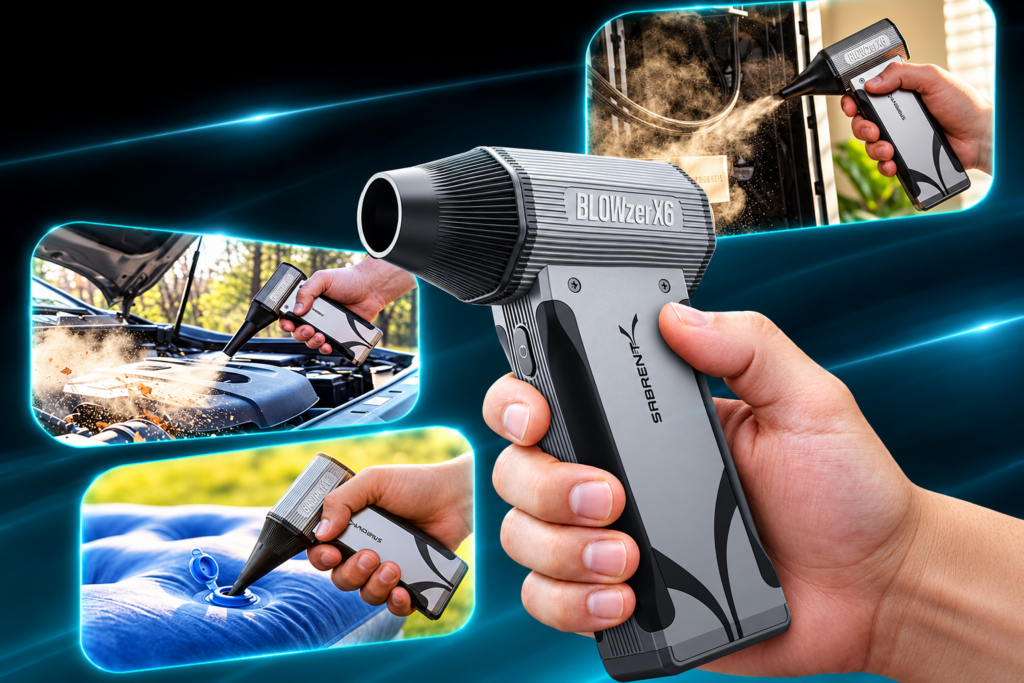
The BLOWZER X6 expands SABRENT’s offering beyond conventional storage and connectivity accessories. This rechargeable electric air duster uses a brushless motor rated up to 130,000 RPM, a 4,000mAh battery, and interchangeable precision nozzles.
Its portable design and carrying case make it useful for cleaning keyboards, computer components, automotive interiors, and workspaces.
Ideal for: PC enthusiasts, electronics owners, and anyone seeking a reusable alternative to disposable compressed-air cans.
The Bigger SABRENT Portfolio: Where Innovation Meets Specialization
Rocket SSDs and the Demand for Faster Storage
SABRENT’s Rocket SSD family represents one of the company’s most recognizable product categories. With options spanning multiple PCIe generations and storage capacities, the Rocket lineup targets customers whose performance requirements exceed those of conventional storage devices.
Modern gaming installations, high-resolution video editing, and large creative projects can place significant demands on storage systems. SABRENT’s SSD development reflects its interest in serving these increasingly demanding applications.
The company has also expanded into portable SSDs, high-capacity memory cards, CFexpress solutions, and PCIe adapters. These products broaden its appeal to photographers, videographers, system builders, and professionals managing substantial amounts of digital information.
Accessories That Complete the Computing Experience
Beyond storage, SABRENT develops Thunderbolt docks, USB switches, external drive enclosures, card readers, networking accessories, and charging cables.
These smaller categories are commercially important because they address the compatibility challenges that arise when customers combine equipment from different manufacturers.
Rather than making every device proprietary, SABRENT concentrates much of its portfolio around established connectivity standards. This helps customers combine existing computers and accessories while selecting the additional hardware their workflows require.
An Original Editorial Analysis: The Connection Friction Index
To examine what distinguishes SABRENT’s product strategy, we developed a qualitative assessment framework called the Connection Friction Index.
This is an original editorial framework, not a consumer poll, laboratory benchmark, or scientifically validated scoring system. It evaluates the six featured products through four recurring sources of inconvenience in everyday computing.
| Friction category | Typical problem | SABRENT’s approach |
|---|---|---|
| Connection limitations | Too few available ports | Expandable USB hubs |
| Storage interruptions | Difficult drive access or migration | Enclosures and docking stations |
| Power fragmentation | Multiple chargers and adapters | Centralized multiport charging |
| Equipment maintenance | Dust and debris accumulation | Rechargeable precision cleaning |
The most interesting finding from this qualitative comparison is that SABRENT does not concentrate exclusively on making computers faster. Much of its product development focuses on making technology easier to organize, connect, maintain, and reuse.
This distinction matters because everyday productivity is influenced by more than processor speed or memory capacity. Eliminating small interruptions can improve the overall experience without requiring a new computer.
Understanding Performance Claims Without the Confusion
Technology marketing frequently highlights impressive numerical specifications, but interpreting them correctly is essential.
According to the USB Implementers Forum, USB 3.2 includes signaling rates of 5Gbps, 10Gbps, and 20Gbps. Those figures describe interface capabilities rather than guaranteed file-transfer performance.
Similarly, Intel identifies 40Gbps connectivity as a core Thunderbolt 4 requirement, alongside certification and defined compatibility standards.
These distinctions are particularly relevant when comparing SABRENT accessories:
- A 10Gbps enclosure cannot guarantee that every installed SSD will achieve that transfer rate.
- A 252W charging station distributes its total capacity across connected devices; it does not provide 252W to every port.
- A Thunderbolt 4 cable cannot independently add Thunderbolt capabilities to a computer that lacks them.
Understanding these limitations helps customers make better purchasing decisions and appreciate the technical reasoning behind product specifications.
Building a More Efficient SABRENT Workspace in Three Steps
A well-designed setup does not require purchasing every accessory available. It begins with identifying the most significant limitations in an existing workflow.
Step 1: Identify your primary bottleneck. Determine whether your biggest inconvenience involves storage speed, charging capacity, peripheral availability, or maintaining equipment. Prioritize the issue that most frequently interrupts your work.
Step 2: Verify compatibility and total requirements. Check available computer ports, supported protocols, power requirements, and storage interfaces. For example, an M.2 NVMe enclosure should not be assumed compatible with every M.2 SATA drive.
Step 3: Build around expansion and maintenance. Select accessories that support your current equipment while leaving room for practical upgrades. Consider cable organization, airflow, storage redundancy, and access to frequently used devices.
This approach transforms individual purchases into a coordinated workspace improvement strategy.
Reliability, Support, and the Long-Term Ownership Experience
Hardware quality matters, but the experience after purchase is equally important. SABRENT emphasizes technical support, product documentation, and warranty coverage as part of its customer relationship.
Selected products qualify for extended warranty periods through registration, although coverage varies by model and may require registration within a specified time after purchase.
The company also provides installation information and troubleshooting resources for customers managing storage devices, connectivity accessories, and more complex hardware configurations.
These services reinforce an important part of SABRENT’s business identity: technology accessories should remain practical and understandable throughout their useful lives, not merely during initial installation.
For customers investing in storage equipment or professional workstation accessories, dependable documentation and access to support are meaningful considerations alongside price and performance.
Why SABRENT Deserves Attention in the Connected Computing Market
SABRENT’s relevance extends across several audiences. Content creators benefit from portable storage and high-bandwidth connectivity. Gamers can expand peripheral access and manage growing game libraries. Office professionals can streamline charging and reduce connection-related interruptions.
Meanwhile, technicians and technology enthusiasts gain access to more specialized equipment for drive management, system upgrades, and maintenance.
The common thread is flexibility. SABRENT does not require every customer to follow the same upgrade path. Instead, its catalog accommodates different levels of technical experience, workspace complexity, and computing ambition.
Final Perspective: Better Technology Begins Between Devices
SABRENT demonstrates how a technology brand can create lasting value by paying attention to the connections between devices.
From its origins in computer components to its established presence in SSDs, docking equipment, and charging technology, the company has developed a broad portfolio around practical computing needs.
Its six featured products show that meaningful improvements can come from faster storage access, more convenient charging, expanded connectivity, simpler drive management, dependable cabling, and easier equipment maintenance.
For customers who want their technology to work together with less friction, SABRENT offers a diverse collection of solutions worth exploring. The brand’s strongest proposition is not simply faster hardware, but a more organized, adaptable, and efficient computing experience.
Research and Technical References
This article draws on SABRENT’s published company history, product documentation, and technical specifications, alongside the USB Implementers Forum’s USB 3.2 Specification and Product Language Guidelines and Intel’s Thunderbolt Technology Overview.
The Connection Friction Index is an independent editorial assessment developed for this article. It does not represent independently collected consumer survey responses or measured product-performance results.