A glowing amber engine icon on the dashboard used to force drivers into an immediate, expensive gamble: pay a dealership diagnostic fee just to learn what went wrong, or ignore the warning and risk a breakdown. BlueDriver built its reputation by handing that diagnostic transparency directly back to vehicle owners. Rather than selling a bare-bones code reader that spits out cryptic alphanumeric strings, the BlueDriver OBD2 Scanner pairs pro-grade Bluetooth hardware with an intelligent mobile platform that translates vehicle data into actionable repair guidance.
What separates BlueDriver from the crowded field of generic automotive gadgets is a clear refusal to hide basic vehicle health behind recurring paywalls. As automotive software increasingly shifts toward monthly memberships, BlueDriver stands out as a no-subscription car code reader designed for everyday commuters, used-car buyers, and weekend DIYers alike. Understanding the brand behind the hardware reveals why millions of drivers keep one tucked permanently inside their glovebox.
Inside the BlueDriver Philosophy: Engineering Clarity Without Recurring Fees
Developed by Lemur Vehicle Monitors, BlueDriver emerged from a straightforward frustration shared by engineers and motorists: professional shop scanners cost thousands of dollars, while budget code readers often lacked the depth to diagnose anything beyond generic powertrain faults. The company set out to bridge that gap by focusing its R&D on a single, tightly integrated hardware-and-software ecosystem. Instead of releasing dozens of fragmented models every year, the brand channels its engineering resources into firmware stability, broader automaker coverage, and seamless smartphone connectivity.
That focused strategy directly supports BlueDriver’s most talked-about brand promise: zero subscription fees. Many competing Bluetooth OBD2 diagnostic scan tools lure buyers with low upfront hardware prices, only to lock enhanced system scans, live sensor graphing, or repair guidance behind annual plans. BlueDriver includes its entire feature suite with the initial hardware purchase, ensuring that drivers never hit a paywall during a roadside emergency.
Several core pillars define the BlueDriver brand experience:
- Unified Hardware and Software: BlueDriver designs its own sensor hardware and develops its own iOS and Android application in-house, eliminating the pairing glitches common with third-party ELM327 knockoffs.
- ASE-Verified Repair Intelligence: Rather than leaving users to sift through conflicting forum threads, the platform pulls from a massive database of real-world fixes reviewed by technicians certified by the National Institute for Automotive Service Excellence (ASE).
- Always-On Human Support: BlueDriver backs its products with 24/7 customer support via phone, email, and in-app chat, treating software troubleshooting with the same urgency as mechanical repairs.
- Continuous Free Updates: As automakers introduce new control modules and protocols, the brand pushes free app and firmware updates to expand compatibility across vehicles built from 1996 onward.
Why Industry Standards and Verified Data Matter in Modern Car Diagnostics
To appreciate what BlueDriver actually accomplishes, it helps to look at the technical standards governing modern vehicles. Under U.S. Environmental Protection Agency (EPA) regulations, every passenger car and light truck sold in the United States since the 1996 model year must comply with the On-Board Diagnostics II (OBD-II) standard. Governed by technical specifications from SAE International—including the SAE J1962 standardized 16-pin connector and SAE J1979 diagnostic test modes—this system allows external tools to communicate with a vehicle’s onboard computer.
Basic code readers only scratch the surface of this architecture, pulling generic emissions-related Check Engine codes. Modern vehicles, however, rely on dozens of specialized electronic control units managing braking, airbags, and tire monitoring. BlueDriver goes further by supporting enhanced OEM diagnostics—covering ABS, SRS (airbag), TPMS, and transmission systems—for a wide range of major domestic, Asian, and European automakers.
According to automotive maintenance data published by the American Automobile Association (AAA), unexpected repair bills routinely catch drivers off guard, with simple diagnostic bench fees often accounting for the first hundred dollars before a wrench ever turns. By generating vehicle-specific Repair Reports that rank the most likely fixes based on millions of verified cases, BlueDriver bridges the knowledge gap between raw SAE fault codes and real-world mechanical solutions.
Closer Look at the Core Hardware: Charcoal vs. Black Editions
While BlueDriver’s software does the heavy lifting, the physical Bluetooth sensor is built for daily durability. The brand offers its flagship diagnostic scan tool in two distinct finishes, allowing drivers to choose their preferred aesthetic without sacrificing a single technical capability.
BlueDriver OBD2 Scanner Bluetooth — Charcoal Edition
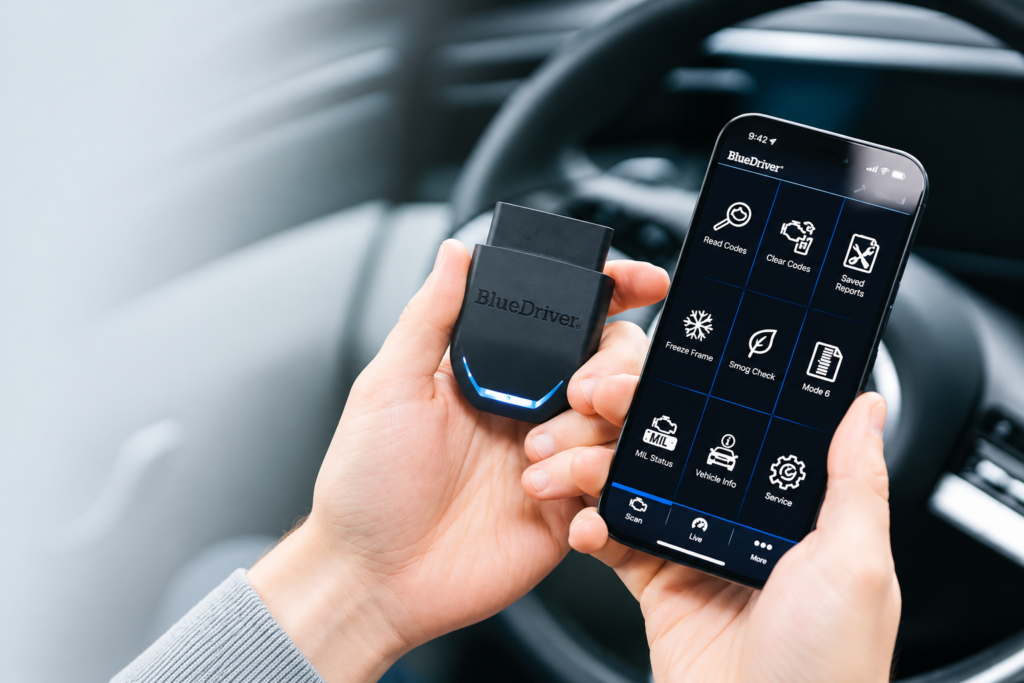
The Charcoal edition brings a refined, modern dark-gray housing to BlueDriver’s signature compact design. Engineered for vehicles from 1996 and newer, this wireless car scanner plugs directly into the under-dash OBD-II port and connects effortlessly to both iPhone and Android devices. It reads and clears Check Engine lights alongside enhanced ABS, SRS, and TPMS codes, delivering full access to Repair Reports, live data, and smog readiness checks with no subscription required.
BlueDriver OBD2 Scanner Bluetooth — Black Edition
The classic Black edition is the longtime staple of the BlueDriver lineup, featuring a low-profile matte-black shell that blends seamlessly into dark footwells and center consoles. Internally, it shares the exact same professional-grade Bluetooth diagnostic architecture as the Charcoal variant. Drivers get full iOS and Android compatibility, 1996+ vehicle support, multi-system scanning (Check Engine, ABS, SRS, TPMS), and lifetime access to verified Repair Reports without ongoing membership costs.
| Feature | BlueDriver Scanner (Charcoal) | BlueDriver Scanner (Black) |
| Exterior Finish | Sleek Dark Charcoal | Classic Matte Black |
| Connectivity | Wireless Bluetooth (iPhone & Android) | Wireless Bluetooth (iPhone & Android) |
| Vehicle Compatibility | Gasoline & Diesel Vehicles (1996+) | Gasoline & Diesel Vehicles (1996+) |
| Diagnostic Scope | Check Engine, ABS, SRS, TPMS & Enhanced OEM | Check Engine, ABS, SRS, TPMS & Enhanced OEM |
| Repair Reports | Included (ASE-Verified Database) | Included (ASE-Verified Database) |
| Subscription Fees | None (One-Time Purchase) | None (One-Time Purchase) |
Beyond the Dongle: The Broader BlueDriver Ecosystem
BlueDriver’s value extends well past the scanner hardware itself. Because the sensor pairs with a continuously evolving mobile platform, owning a BlueDriver device grants access to a full diagnostic toolkit that adapts to different stages of car ownership. Drivers can monitor real-time engine metrics—such as coolant temperature, fuel trims, and O2 sensor voltages—through customizable live-data graphs that can be exported for later review.
The brand also supports practical ownership utilities and accessories that round out the experience:
- Smog Check Readiness Module: Verifies whether your vehicle’s emissions monitors are set to “Ready” before you visit a state inspection station, preventing failed tests after a battery replacement.
- Freeze Frame & Mode 6 Data: Captures the exact engine conditions—speed, RPM, and temperature—at the precise millisecond a fault occurred, helping trace intermittent glitches.
- Official Carrying Cases: BlueDriver offers custom-fitted protective zipper cases designed to shield the OBD-II pins from dust, moisture, and loose clutter inside a tool bag or glove compartment.
- Multi-Vehicle Utility: Unlike VIN-locked diagnostic tools that charge extra fees for additional cars, a single BlueDriver sensor can scan every compatible vehicle in a household, making it invaluable when inspecting a used car before purchase.
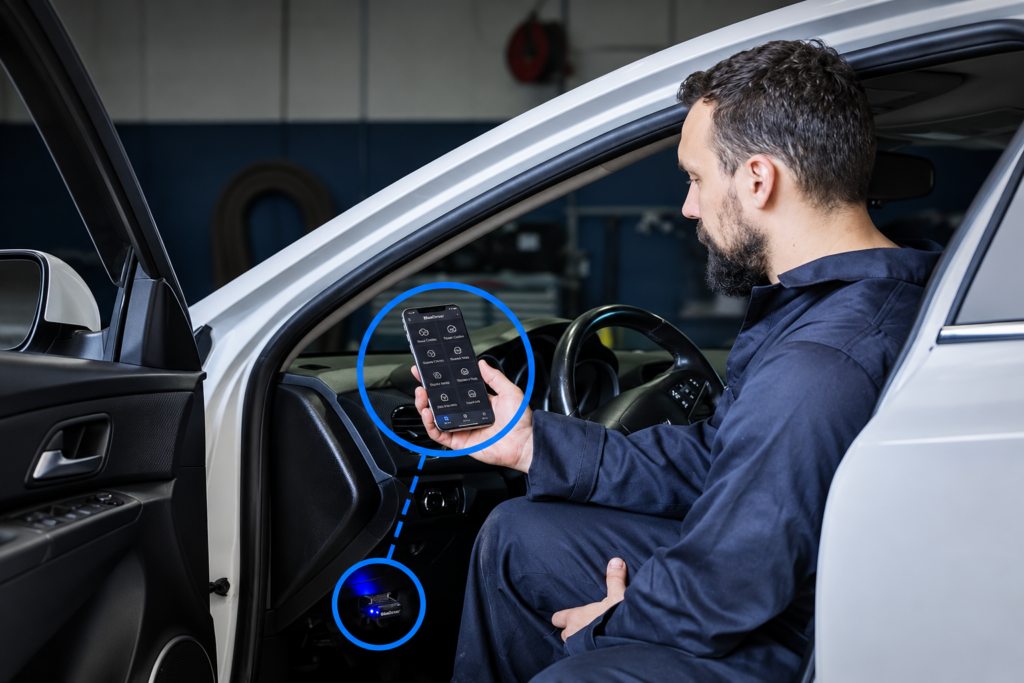
How to Run a Pro-Level Diagnostic Scan at Home
Using a Bluetooth OBD2 scanner does not require mechanical training. Following a structured sequence ensures accurate readings and protects your vehicle’s electronics:
- Locate the OBD-II Port: Look beneath the dashboard on the driver’s side, usually near the steering column or above the brake pedal.
- Plug In the BlueDriver Sensor: Firmly insert the scanner into the 16-pin SAE J1962 connector until the indicator light confirms power.
- Turn the Ignition to “On”: Switch the vehicle to the accessory/on position without starting the engine (or start the engine if you plan to record live driving data).
- Launch the BlueDriver App: Open the app on your iPhone or Android device and allow it to pair automatically via Bluetooth—no manual PIN entry is required.
- Scan and Generate a Repair Report: Select “Read Codes,” choose a full system scan (including ABS, SRS, and TPMS where supported), and tap “Repair Reports” to review the ranked fixes and estimated parts needed.
Original Analysis: The Real Economics of DIY Diagnostics vs. Shop Visits
To evaluate whether a dedicated OBD2 scanner truly pays for itself, we analyzed standard automotive service pricing trends alongside typical multi-year vehicle ownership cycles. Across independent repair shops and franchise dealerships, a baseline diagnostic inspection typically ranges from $100 to $180 per visit—and that fee rarely includes the actual repair. When a driver owns a vehicle for five to seven years, encountering just two or three warning lights (such as a loose gas cap triggering an EVAP code, a failing wheel speed sensor activating the ABS light, or an aging oxygen sensor) can easily result in $300 to $500 spent strictly on fault identification.
Our perspective is straightforward: the greatest financial return from a tool like BlueDriver isn’t just saving money on DIY wrenching—it is eliminating information asymmetry at the repair counter. Even if you never plan to turn a socket wrench yourself, walking into a service bay knowing the exact fault code and the top three verified fixes transforms the conversation. You can quickly distinguish a $15 replacement cap from a major catalytic converter issue, get accurate phone quotes from competing mechanics, and avoid unnecessary diagnostic markups.
In an automotive market where routine maintenance costs keep climbing and digital subscriptions creep into every corner of car ownership, BlueDriver maintains a refreshingly practical standard. By pairing durable, thoughtfully designed hardware in Charcoal and Black finishes with a genuinely free, ASE-backed software platform, the brand delivers lasting peace of mind every time you turn the key.